The past month, by the numbers:
3- different Christmas gigs
8- nights that I've played Christmas music
12- Christmas shows performed
24- number of hours that I've played/listened to Christmas music
30- number of times I played "Deck the Halls"
_59-amount of money paid for services
It's not hard to bemoan all I've endured for the sake of some more money in the bank, but ultimately I wouldn't do all this if I didn't like it or find any personal value or growth through the opportunities these shows have provided me. I've met some really cool people (musicians are artists, after all) and had some really good laugh in between periods of boredom and tedium.
Showing posts with label orchestra. Show all posts
Showing posts with label orchestra. Show all posts
Saturday, December 24


Saturday, December 3
Stages of grief: Christmas edition

http://www.nataliedee.com/121710/
By the twelfth day of this month I will have played about 20 hours' worth of Christmas music, which includes having played "Jingle Bells" sixty times. This is not the first time this has happened, and I've already gone through enough Christmas shows to anticipate how I will feel about Christmas as a result of playing almost every song imaginable related to this most festive winter holiday:
1. Denial
At first I think, pfft I'll be alright, I've done this several times before. I'm immune to Christmas fatigue, ha ha ha!
2. Anger
I will start to fantasize about roasting Rudolph over an open fire and punching Jack Frost in the nose. The anger will translate into a brusque fortissimo on poor Julian Matthias, my violin.
3. Bargaining
I mark time with each piece and force myself to remember that I'm getting paid to play this music, and there are much worse ways to earn money.
4. Acceptance (I don't usually have enough energy to go through the real step 4 from the Kübler-Ross model)
Every song I play is so bad that it becomes good, and, ironically or not, I actually start to enjoy playing all that music and sing along when I can (despite my lack of singing voice).
Sunday, November 13
This one time during a show...
There is no such thing as a perfect show. Whether the oops happens on stage, behind it, or in the pit, it just happens. Such is life.
One time, in the sixth show of a ten-show run, one of the stage hands or stage managers was absent, and the conductor told us in the pit orchestra that one of the transitions might take some extra time and that we'd have to repeat short scene change music. So, when the time came, we all repeated the sequence. After playing it twice the conductor made small circles in the air with his hand to indicated to keep playing. And so we did. For maybe 2 minutes, repeating the scene change music about 20 times.
This scene change music was obnoxiously cheery, and at first I couldn't stop giggling at the fact that we were playing it over and over again. Eventually my midsection was sore from trying to stifle myself and I started to get concerned: what was happening backstage that was causing this delay? The audience, luckily, overcame its initial confusion and started to clap along to the music as it continued on and on...and when the lights finally were raised to reveal the new set, they applauded and cheered (with joy? with relief?). The actor who walked onto that scene ad libbed the line, "It's funny, I've had this song stuck in my head...". I don't know whose burst of laughter was greater, the audience's or the pit orchestra's. It made us feel relieved and gave us a chance to make some audible noise that came from ourselves and not our instruments.
We learned during intermission that, in addition to being a man down, a piece of the scenery got stuck or hooked to one of the fly's that was being lifted up, and the delay was mostly due to trying not to have one or the other fly come crashing down onto the stage. Eventually gravity helped to wiggle the stuck piece off and bring down the correct scenery for the next scene.
Most of the time the mistake comes in the form of a missed cue or forgotten line or mic issue, and these mistakes happen so frequently as to be almost unremarkable, forgettable. But this is one instance I will never forget.
One time, in the sixth show of a ten-show run, one of the stage hands or stage managers was absent, and the conductor told us in the pit orchestra that one of the transitions might take some extra time and that we'd have to repeat short scene change music. So, when the time came, we all repeated the sequence. After playing it twice the conductor made small circles in the air with his hand to indicated to keep playing. And so we did. For maybe 2 minutes, repeating the scene change music about 20 times.
This scene change music was obnoxiously cheery, and at first I couldn't stop giggling at the fact that we were playing it over and over again. Eventually my midsection was sore from trying to stifle myself and I started to get concerned: what was happening backstage that was causing this delay? The audience, luckily, overcame its initial confusion and started to clap along to the music as it continued on and on...and when the lights finally were raised to reveal the new set, they applauded and cheered (with joy? with relief?). The actor who walked onto that scene ad libbed the line, "It's funny, I've had this song stuck in my head...". I don't know whose burst of laughter was greater, the audience's or the pit orchestra's. It made us feel relieved and gave us a chance to make some audible noise that came from ourselves and not our instruments.
We learned during intermission that, in addition to being a man down, a piece of the scenery got stuck or hooked to one of the fly's that was being lifted up, and the delay was mostly due to trying not to have one or the other fly come crashing down onto the stage. Eventually gravity helped to wiggle the stuck piece off and bring down the correct scenery for the next scene.
Most of the time the mistake comes in the form of a missed cue or forgotten line or mic issue, and these mistakes happen so frequently as to be almost unremarkable, forgettable. But this is one instance I will never forget.
Monday, October 24
World-renown very good sport, indeed
An appearance on Sesame Street is a good indicator that you're famous and noteworthy. If kids should know your name, everyone should. God bless Seiji Ozawa for his commitment to his role as conductor of this animal orchestra, not winking at the camera at all, taking his job seriously as he gives cues and gestures to draw out a crescendo of meows.
See those shots of Ozawa from the front? He could be conducting an actual orchestra, with that kind of dedication on his face. What a very good sport.
See those shots of Ozawa from the front? He could be conducting an actual orchestra, with that kind of dedication on his face. What a very good sport.
Saturday, October 22
Classical music rocks! Really!
Classical music is largely the genre composed by dead white (European) men, true, and has a reputation for being boring and pretentious—so much so that a few years ago some convenience store owners decided to blare it outside their doors to keep out ne’er-do-well teenagers. I believe that the owners were successful in keeping out the bored adolescents that haunt these places, but I’m guessing they alienated other people, too (some of them "thugs"? eh, gives me uncomfortable feelings about classism...).
For me, baroque music is the hardest to appreciate unless you’ve actually played it before. Beethoven straddles the line between this older, stodgier classical music and the more dynamic classical music, the kind that elicited polarizing reactions. I wonder if any of those owners played any of Beethoven’s symphonies; I think those pieces are the easiest to get into for the beginning classical music appreciater. I’ve recently gotten more into Rachmaninov, who is complex but not obtuse, emotional and passionate but also maintains nuance. Maybe my favorite composer is Dvorak; in season 2 episode 7 of Glee the theme from the last movement of his “New World” Symphony was played for a few seconds to the slo-mo visual of a sneeze, turning it into an Epic Sneeze. I’m not a rabid fan of that show any more, but I have to hand it to whoever chose that music to go along with that footage. I squealed out loud at that part, because I instantly recognized that music and was delighted that thousands of Glee-watchers had also heard it and enjoyed it and have been exposed to some Dvorak. Again, it’s not much, but I’m grateful for what it was, and I hope that other shows put in bits of classical music.
(could not find clip of the scene on Youtube, sneeze music starts at 0:16)
(could not find clip of the scene on Youtube, sneeze music starts at 0:16)
This genre is still changing and evolving, despite its name. There are some pretty out-there, intellectual modern classical music symphonies out there—I’ve played a few of them. Think of the soundtrack for Inception, which had the traditional symphony orchestra but included electric guitar—epic. Really, how many things are more epic than that, than that movie’s soundtrack?! I won’t begrudge Trent Reznor’s Oscar win, but Hans Zimmer is an awesome, cutting-edge composer who is building off this supposedly-dull music genre.
Wednesday, September 28
Julian Matthias and I: A-string number one!
As previously mentioned, the a-string on the violin is the status quo, the string that is used to tune an orchestra. It is the highest open string note on viola and cello.
One of my favorite sounds in the world is the sound of an orchestra tuning. I almost want to say it's not a musical sound because technically it's not music, it's not a tune that you can hum even though you can hum the pitch. The technical perfect A pitch is A440, and depending on the oboe or the piece the a-string will be tuned higher or lower accordingly. There are a lot of marks on Julian Matthias' fingerboard right under the a-string; it's probably the most used string as a result. (Just reminded me that there's probably a musician-related joke about knowing how to finger properly...eh, too lazy to find one.)
I think that the first note I ever played on Julian Matthias was an open A-- I played the a string as it was, with no fingers, just the clean and unadulterated note, just to hear how the sound would carry out of the instrument. Julian Matthias' maker was Chinese; the other violin that I was considering at the time was German (not that this information swayed my opinion on which one to choose to purchase).
One of my favorite sounds in the world is the sound of an orchestra tuning. I almost want to say it's not a musical sound because technically it's not music, it's not a tune that you can hum even though you can hum the pitch. The technical perfect A pitch is A440, and depending on the oboe or the piece the a-string will be tuned higher or lower accordingly. There are a lot of marks on Julian Matthias' fingerboard right under the a-string; it's probably the most used string as a result. (Just reminded me that there's probably a musician-related joke about knowing how to finger properly...eh, too lazy to find one.)
I think that the first note I ever played on Julian Matthias was an open A-- I played the a string as it was, with no fingers, just the clean and unadulterated note, just to hear how the sound would carry out of the instrument. Julian Matthias' maker was Chinese; the other violin that I was considering at the time was German (not that this information swayed my opinion on which one to choose to purchase).
Thursday, August 4
Unintentional eye contact
I'm a dreamer, and sometimes I'll zone out while staring at a fixed point in space; it might be a spot on the ceiling or someone's face, just as long as it's in my line of vision. Unfortunately this can lead to An Awkward Situation: accidental/unintentional eye contact with a near-stranger. Usually it's someone I don't know very well. This is easy to do during orchestra rehearsals, when I daydream and just happen to be staring at whoever is across from me within another instrument section. I don't study that person's face but merely rest my eye on that person's visage, and inevitably they'll accidentally look my way since I'm probably in their line of vision and...there's that brief moment when we'll look at each other, and then we blink and look away.
Sunday, July 17
Instruments and the people who play them, part II
click here for part I
Trumpet/cornet players
Not a shy bunch are these musicians. This isn't to say that they're all in-your-face extroverts, but generally trumpet players don't have a problem speaking their minds and making themselves heard. The brass section is usually pretty male-dominated with a few females sprinkled here and there.
Trombone players
In my experience, trombone players have the best sense of humor out of all the brass players. Trombones always go in front in parades because having them follow any section would be hazardous, to say the least (the slide part extends preeetty far out). To me the trombone is sort of the odd man in the brass section because there are no valves to press down and it takes a certain kind of person and precision to differentiate between the positions for notes.
French horn players
I think that at one point in time French horn players were considered unreliable, but all the ones I've met are very reliable and intelligent. Definitely some of the smartest people I knew in high school were French horn players. I've been told that the instrument has the smallest mouthpiece and therefore is the most difficult brass instrument to play-- it's hard to get a really good sound out of it. Also, it seems that French horn players are constantly transposing ("translating" from the key of one instrument to another). The French horn is unique in that it has an ambient sound that emanates in all directions, whereas most brass instruments just project wherever the bell part is focused.
Baritone/tuba players
Unfortunately I lump these two different instrument groups together because I just have not met enough of either type of musician to make a fair stereotype out of them. They are an eclectic bunch and defy definition. There's a sterotype that tuba players are large men who are about the same size as their instrument, but the ones I've met are all on the slim side. I think baritone horn players are slightly more goofy/ humourous than tuba players, but I find most brass players to be pretty good-natured and relaxed in comparison to other instrumentalists.
Trumpet/cornet players
Not a shy bunch are these musicians. This isn't to say that they're all in-your-face extroverts, but generally trumpet players don't have a problem speaking their minds and making themselves heard. The brass section is usually pretty male-dominated with a few females sprinkled here and there.
Trombone players
In my experience, trombone players have the best sense of humor out of all the brass players. Trombones always go in front in parades because having them follow any section would be hazardous, to say the least (the slide part extends preeetty far out). To me the trombone is sort of the odd man in the brass section because there are no valves to press down and it takes a certain kind of person and precision to differentiate between the positions for notes.
French horn players
I think that at one point in time French horn players were considered unreliable, but all the ones I've met are very reliable and intelligent. Definitely some of the smartest people I knew in high school were French horn players. I've been told that the instrument has the smallest mouthpiece and therefore is the most difficult brass instrument to play-- it's hard to get a really good sound out of it. Also, it seems that French horn players are constantly transposing ("translating" from the key of one instrument to another). The French horn is unique in that it has an ambient sound that emanates in all directions, whereas most brass instruments just project wherever the bell part is focused.
Baritone/tuba players
Unfortunately I lump these two different instrument groups together because I just have not met enough of either type of musician to make a fair stereotype out of them. They are an eclectic bunch and defy definition. There's a sterotype that tuba players are large men who are about the same size as their instrument, but the ones I've met are all on the slim side. I think baritone horn players are slightly more goofy/ humourous than tuba players, but I find most brass players to be pretty good-natured and relaxed in comparison to other instrumentalists.
Saturday, July 16
Rank
Pit orchestra is so much fun! I may sit down the whole time but I still feel like I get a really good workout, especially for my arms and hands. I'm fresh out of a show and the left hand fingertips are a bit sore as I type this; they're sore and a bit harder and calloused from lots of action on the violin.
The music is fun to play and all the other musicians are good-natured and working hard to get the right performance out of their instrument, and in the process work up quite a sweat. Tonight this fact was particularly obvious. The pit in which I played tonight is rather cavern-like, so it's not ventilated well and traps heat easily. By the end of Act I there were some pretty funky smells wafting about the place and we unanimously decided not to linger there during intermission but to leave the pit and air our bodies out a little. In Act II some of the musicians in front of me checked their armpits after a show-stopping, high energy number; it was played to comic effect but they were serious about making sure that they weren't rank, that they weren't the ones responsible for making the pit odorific.
I have to do a good job apply deodorant for the next show.
The music is fun to play and all the other musicians are good-natured and working hard to get the right performance out of their instrument, and in the process work up quite a sweat. Tonight this fact was particularly obvious. The pit in which I played tonight is rather cavern-like, so it's not ventilated well and traps heat easily. By the end of Act I there were some pretty funky smells wafting about the place and we unanimously decided not to linger there during intermission but to leave the pit and air our bodies out a little. In Act II some of the musicians in front of me checked their armpits after a show-stopping, high energy number; it was played to comic effect but they were serious about making sure that they weren't rank, that they weren't the ones responsible for making the pit odorific.
I have to do a good job apply deodorant for the next show.
Thursday, July 7
Julian Matthias and I: Withdrawal?
I've come fresh out of a dress rehearsal but I'm already thinking about withdrawal. It's not that I want to withdraw from the show, but that I'm preemptively feeling for the actors and the production people involved. I don't know how long they've been working on this production-- for weeks at least, maybe a month or two. This week has probably been the most joyous and stressful, since this Friday marks the very first show. All that hard work and rehearsing will be on display and it's showtime, quite literally. And before we all know it we'll be performing the last show, and then it'll be over. There will be no more "next rehearsal" or "next show" to make it better or amend mistakes or relive the thrill of receiving applause after that particularly exhausting yet thrilling show-stopping number. It's a relief once it's all over, but then immediately there's also a feeling of nostalgia and mourning, almost, that it's all over and it's gone, it will never happen quite that way again.
I know "nostalgia" is usually used in reference to childhood memories; I don't know what the prefix "nost-" means, but "-algia" refers to pain-- think myalgia (pain in muscles) or neuralgia (nerve pain). Nostalgia means "to look back with pain", and I think that it's very fitting for the feeling of After The Show's Over. Withdrawal, too, feels like an apt description, as theatre is like a drug: there are very high ephemeral highs, and there are very stressful, dark lows when everything is going wrong and it doesn't seem like there's a chance that the show will go on or be presentable in any way. There's a lot of sturm and drang that goes into putting on a show, but the people involved think that it's all worth it in the end, that all the energy and money and emotion that goes into it is of value, just as a junkie will sell everything s/he owns to get just one more hit.
Ach, I didn't intend for this post to be so depressing! It's just that I'm anticipating this feeling for others. As a pit orchestra musician I have probably the least amount of involvement for someone involved in the production. I just have to show up and play, and it's someone else's problem if the sound doesn't work or the music cues don't match up. I'm heard but not seen, and I like it that way. But I've been on the other side of the stage, I've been a performer on stage in a theatrical production before, and I wish nothing but the best for everyone else who's worked literally day and night on this production. The dress rehearsal was fraught with technical difficulties, but I stand by the superstition that if a dress rehearsal goes badly the actual run of the show will go well.
I know "nostalgia" is usually used in reference to childhood memories; I don't know what the prefix "nost-" means, but "-algia" refers to pain-- think myalgia (pain in muscles) or neuralgia (nerve pain). Nostalgia means "to look back with pain", and I think that it's very fitting for the feeling of After The Show's Over. Withdrawal, too, feels like an apt description, as theatre is like a drug: there are very high ephemeral highs, and there are very stressful, dark lows when everything is going wrong and it doesn't seem like there's a chance that the show will go on or be presentable in any way. There's a lot of sturm and drang that goes into putting on a show, but the people involved think that it's all worth it in the end, that all the energy and money and emotion that goes into it is of value, just as a junkie will sell everything s/he owns to get just one more hit.
Ach, I didn't intend for this post to be so depressing! It's just that I'm anticipating this feeling for others. As a pit orchestra musician I have probably the least amount of involvement for someone involved in the production. I just have to show up and play, and it's someone else's problem if the sound doesn't work or the music cues don't match up. I'm heard but not seen, and I like it that way. But I've been on the other side of the stage, I've been a performer on stage in a theatrical production before, and I wish nothing but the best for everyone else who's worked literally day and night on this production. The dress rehearsal was fraught with technical difficulties, but I stand by the superstition that if a dress rehearsal goes badly the actual run of the show will go well.
Wednesday, July 6
My "Where's Waldo?"
I'm one of those people who likes to sit and watch the entire movie credits at the end of a film. My reason for this is probably different than many other peoples.
Why would people want to stay for the credits?
1. To watch the bloopers
Examples include: many Jackie Chan movies (Supercop, the Rush Hour movies), some Pixar films (the first two Toy Story films, A Bug's Life as well, I think). I'm sure there are more movies that fit in all the categories I list here but they don't readily come to my mind
2. To look out for a bonus/epilogue scene that may tie into a sequel
The Pirates of the Caribbean series and any film connected to the behemoth Avengers film has done this. Captain America: The First Avenger hasn't come out yet, and I haven't seen the entirety of either Iron Man film but I know that all these films have a tag/tie-in scene after the main plot of the film has officially ended.
Why would people want to stay for the credits?
1. To watch the bloopers
Examples include: many Jackie Chan movies (Supercop, the Rush Hour movies), some Pixar films (the first two Toy Story films, A Bug's Life as well, I think). I'm sure there are more movies that fit in all the categories I list here but they don't readily come to my mind
2. To look out for a bonus/epilogue scene that may tie into a sequel
The Pirates of the Caribbean series and any film connected to the behemoth Avengers film has done this. Captain America: The First Avenger hasn't come out yet, and I haven't seen the entirety of either Iron Man film but I know that all these films have a tag/tie-in scene after the main plot of the film has officially ended.
Tuesday, June 21
Julian Matthias and I: Worst audition ever
My worst audition ever took place either at the very end of August or the very beginning of September. The air was still warm and sunny but there was a palpable coolness the atmosphere that couldn't be completely attributed to cooler breezes. The new school year was approaching with great rapidity, and my lack of practising violin over the summer was inescapable.
I quickly ran out of tomorrows and found myself rushing to pack Julian Matthias up and stuff my music into my bag to leave for my audition. I got there 20 minutes so that I had enough time to warm up and cycle through the four stages of grief about three times before I would get called in to be audited, to be judged. I read an article recently about how, before a workout or any kind of athletic activity, it's not good to spend too much time getting warmed up because it can make one tired and unnecessarily worn out. I think this can be applied to the performing arts as well, where it's important to get all the muscles stretched and ready for showtime but there is such thing as overdoing it, over-warming up. With five minutes to go I stopped and went to wait outside.
A fellow female violinist came out of the room a few minutes later. She wore her hair in a high ponytail tied with a ribbon, a clean white blouse tucked into a skirt that hit right above her knees, and dress shoes. She gave me a sympathetic smile before rushing to put away her instrument, leaving me more nervous and giving me one more item to my "shoulda/woulda/coulda" list of things to do before the audition. A few weeks earlier I had talked to a friend about my audition and she advised me to look nice and wear a skirt. "He (the conductor of the orchestra for which I was auditioning) likes girls who dress like girls", she had said. I don't remember what I wore to the audition and back then I gave much less thought to the way I dressed and did my hair than I do now.
As with most auditions, this one was a blur. I remember being told to start when ready; I remember playing and not executing difficult passage well; I remember stopping and already knowing that I had done terribly. The adjudicators were kind about it though. Or rather, they didn't openly express their disgust at having spent that time listening to me struggle. One of them noticed that I had written in that I also played the clarinet. I said yes, yes I do play the clarinet as well. There might've been an exchange of glances between the two. They thanked me and let me leave.
Ach! Right after I left I realized that the man who asked about clarinet playing was a clarinetist himself! And I knew his son, an oboe player, and had sat next to his son many times in the high school band! I should've made some witty comment about "us clarinet players, amiright?" But I didn't. And it wouldn't have made a difference.
To this day that is my worst audition ever, and I work to make sure it stays that way.
I quickly ran out of tomorrows and found myself rushing to pack Julian Matthias up and stuff my music into my bag to leave for my audition. I got there 20 minutes so that I had enough time to warm up and cycle through the four stages of grief about three times before I would get called in to be audited, to be judged. I read an article recently about how, before a workout or any kind of athletic activity, it's not good to spend too much time getting warmed up because it can make one tired and unnecessarily worn out. I think this can be applied to the performing arts as well, where it's important to get all the muscles stretched and ready for showtime but there is such thing as overdoing it, over-warming up. With five minutes to go I stopped and went to wait outside.
A fellow female violinist came out of the room a few minutes later. She wore her hair in a high ponytail tied with a ribbon, a clean white blouse tucked into a skirt that hit right above her knees, and dress shoes. She gave me a sympathetic smile before rushing to put away her instrument, leaving me more nervous and giving me one more item to my "shoulda/woulda/coulda" list of things to do before the audition. A few weeks earlier I had talked to a friend about my audition and she advised me to look nice and wear a skirt. "He (the conductor of the orchestra for which I was auditioning) likes girls who dress like girls", she had said. I don't remember what I wore to the audition and back then I gave much less thought to the way I dressed and did my hair than I do now.
As with most auditions, this one was a blur. I remember being told to start when ready; I remember playing and not executing difficult passage well; I remember stopping and already knowing that I had done terribly. The adjudicators were kind about it though. Or rather, they didn't openly express their disgust at having spent that time listening to me struggle. One of them noticed that I had written in that I also played the clarinet. I said yes, yes I do play the clarinet as well. There might've been an exchange of glances between the two. They thanked me and let me leave.
Ach! Right after I left I realized that the man who asked about clarinet playing was a clarinetist himself! And I knew his son, an oboe player, and had sat next to his son many times in the high school band! I should've made some witty comment about "us clarinet players, amiright?" But I didn't. And it wouldn't have made a difference.
To this day that is my worst audition ever, and I work to make sure it stays that way.
Tuesday, May 31
Julian Matthias and I: Evening of Opera
My last orchestra concert featured Italian opera music, and this piece was my favorite, hands down. Opera music is generally boring for the second violin because it usually features lots of repitition and little opportunity to play the melody or some kind of rhythm. If we do get to play the melody, it's usually an octave below the firsts. That was how it was in the case of "O Soave Fanciulla", but I didn't mind it. The beginning part follows the tenor voice and allows for more hammy, dramatic playing. For the performance the tenor and soprano did in fact sing the last part of the song from off-stage, just as Pavarotti and Freni did above. They sing "amor" three times as the music gradually gets softer until it's just a whisper of the sustained note. But, of course, the audience does it's best to savor the magic quietness before erupting in applause.
I love opera music. Does that make me a romantic? I love how it's so dramatic and passionate, and it never bores me. It doesn't matter that it's sung in a language I can't understand-- even if the lyrics have been translated into English it's difficult to make out the words. As much as I love words, they don't even really matter that much to me when it comes to opera because I can make out the emotions and the character's motivation through the way it is sung and how it fits into the orchestral accompaniment. Music is a universal language, and no matter how silly or improbable the plots and situations in operas they all deal with real and powerful human emotions.
Friday, May 27
Wings
In my limited experience in the world of ballet, the wings of a stage was where dancers were still just regular people who happened to be dressed in snazzy costumes. Not all of them would walk gracefully; when in pointe shoes it's hard to walk with a natural gait so ballerinas have to compromise by walking duck-like-- think "walking with flippers" but not as goofy. Some would sit right up against the panels that divided up the space in the wings (I know there's a proper, technical stage term for these, I just can't think of it at the moment) and sit or stretch or squirt water into their mouths (so as not to mess up any lip products). There's no need to whisper in the wings because the music from the pit is usually loud enough to cover up noise, but everyone still uses his/her indoor voice to communicate. And, as shown in movies such as Phantom of the Opera and Black Swan, there is a box of powdery rosin on either side of the stage for a ballerina to rub her shoes into, to give some traction and prevent slipping on stage.
In my slightly less limited experience in working backstage in a theatrical production, the wings are much more quiet, but not necessarily less calm. Actors are in various states of being in character; some maintain their character's way of walking and talking, others completely revert back to their typical selves. There's a lot more nonverbal and quiet communication, because even if a scene has background music the audience usually would still be able to hear people talking in the wings. People stretch and move around as silently as possible, to stay loose and/or expend any extraneous energy.
Both these scenarios are also infiltrated by the ninja-like stagehands, working to be seen and heard as little as possible and be efficient to the point of being overlooked. I like how the wings are filled with so much action to the point that what happens there could be a show itself, nevermind whatever's happening on stage. Whenever I see a stage production I can't help but wonder what's going on in the wings, what mishaps and close calls were had there. I like the immediacy of working there, the slight unsung-hero aspect of the sturm und drang of what happens just off stage so that whatever's happening on stage unfolds seamlessly. Performers spend days, weeks, months anticipating each performance, whether it's a one-night deal or multi-week run, and the wings are the last place-- the final safe space-- before proceeding on past Go and collecting $200 and transforming into whatever stage persona she/he has prepared to inhabit.

In my slightly less limited experience in working backstage in a theatrical production, the wings are much more quiet, but not necessarily less calm. Actors are in various states of being in character; some maintain their character's way of walking and talking, others completely revert back to their typical selves. There's a lot more nonverbal and quiet communication, because even if a scene has background music the audience usually would still be able to hear people talking in the wings. People stretch and move around as silently as possible, to stay loose and/or expend any extraneous energy.
Both these scenarios are also infiltrated by the ninja-like stagehands, working to be seen and heard as little as possible and be efficient to the point of being overlooked. I like how the wings are filled with so much action to the point that what happens there could be a show itself, nevermind whatever's happening on stage. Whenever I see a stage production I can't help but wonder what's going on in the wings, what mishaps and close calls were had there. I like the immediacy of working there, the slight unsung-hero aspect of the sturm und drang of what happens just off stage so that whatever's happening on stage unfolds seamlessly. Performers spend days, weeks, months anticipating each performance, whether it's a one-night deal or multi-week run, and the wings are the last place-- the final safe space-- before proceeding on past Go and collecting $200 and transforming into whatever stage persona she/he has prepared to inhabit.

Monday, May 23
Character sketch: Niko
Niko sat in front of me in orchestra, which gave me ample opportunities to look at his profile and his hands. OH, those hands. They could've been hand model hands, they were so beautiful; with that rich olive skin tone, and long nimble fingers that produced an enviable vibrato and traversed the fingerboard with ease. I kind of wished that I had his hands, but that would be awkward and probably wouldn't suit me aesthetically or musically.
I took an immediate liking to him because he was a violinist and had nice hands. (Okay, and he was good-looking, something nice to stare at during rests.) Unfortunately he turned out to be, well, kind of a saukerl. He was not actively dislikeable-- he didn't go out of his way to annoy others-- but he hung out with guys who were aggresively cocky and full of disdain for everyone else. On his own he was relatively polite and laconic, but he was a slacker and clearly rided on his good looks and charm to get by. But he really was a good violinist-- about the same level as me, at the time, but maybe slightly better in terms of technical skill. And as I've said before, it's really hard to fake it when it comes to playing the violin. Niko came off as not caring too much about the violin, as if he just did it because he was good at it and it was something to do to pass the time before catching up with his asinine friends.
I took an immediate liking to him because he was a violinist and had nice hands. (Okay, and he was good-looking, something nice to stare at during rests.) Unfortunately he turned out to be, well, kind of a saukerl. He was not actively dislikeable-- he didn't go out of his way to annoy others-- but he hung out with guys who were aggresively cocky and full of disdain for everyone else. On his own he was relatively polite and laconic, but he was a slacker and clearly rided on his good looks and charm to get by. But he really was a good violinist-- about the same level as me, at the time, but maybe slightly better in terms of technical skill. And as I've said before, it's really hard to fake it when it comes to playing the violin. Niko came off as not caring too much about the violin, as if he just did it because he was good at it and it was something to do to pass the time before catching up with his asinine friends.
Friday, May 6
Julian Matthias and I: Trying to Get a Hickey
It’s the mark of a true violinist--sort of. It funny that, of all places, I first learned about the hickey at church, and then started to want one myself.
Monday, May 2
Julian Matthias and I: The day of the concert

Monday, April 11
Quick (over)analysis of New Era commercial
New Era commercial featuring actors Alec Baldwin and John Krasinski exchanging baseball trash talk:
I like. Things that pique my interest?
I like. Things that pique my interest?
Saturday, April 2
Julian Matthias and I: Playing second fiddle
I haven't sat down and worked out the stats but I'd say that 60-70% of the time that I've been in an orchestra I've played the second violin part. So I've spent a fair amount of time literally playing second fiddle. Which isn't always such a bad thing.
Tuesday, March 8
Julian Matthias and I: First gig!
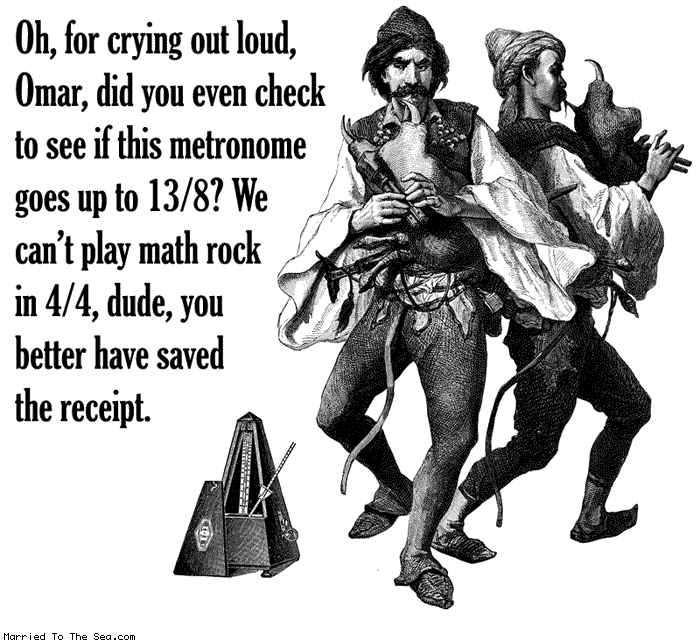
I think that atonality and excessive changes in time signature are requisite when it comes to composing modern orchestral works. At least that's what it's felt like in my (limited) experience when it comes to that type of music.
For my first-ever gig as a violinist I played in a chamber symphony and performed an original modern classical composition. My violin teacher's friend was working on his master's degree in composition and that concert was (part of) his master's thesis. In retrospect I feel like my violin teacher rounded up the required number of string players but one of them backed out in the last minute, and that's how I got the gig. I was definitely the youngest of all the musicians, but everyone treated me as an equal and no one gave me dirty looks for the countless mistakes I made.
We had two or three rehearsals before the concert, and everyone made mistakes. Even the conductor, who wasn't the composer. There were multiple key changes, tempo changes, switches in time signature and no easily discernable melody. It had phrases but nothing that you could easily remember and hum on your way out of the theater. It might be the single most challenging thing I've ever had to play. And yet...I had a lot of fun. I loved that I got to play an original piece with such talented people, and the composer was so earnestly thankful that we took on his composition. He gave us each of us thank you cards and a bottle of wine as a token of appreciation. Well, actually, he gave everyone else wine; I was seventeen at the time and got a gift card to The Body Shop instead, which was well and fine and I used it to buy makeup for prom. But the point is that he was so pleased that he got to hear what he wrote played by human beings and his happiness was infectious. It was a great first gig, an enjoyable little romp into the world of musicians.
image source
Subscribe to:
Posts (Atom)